
We bring the methodology from elite athlete care to your everyday needs.
Coaching. Biomechanics. Real progress. For everyone who hasn't had access to measurable, long-term solutions.
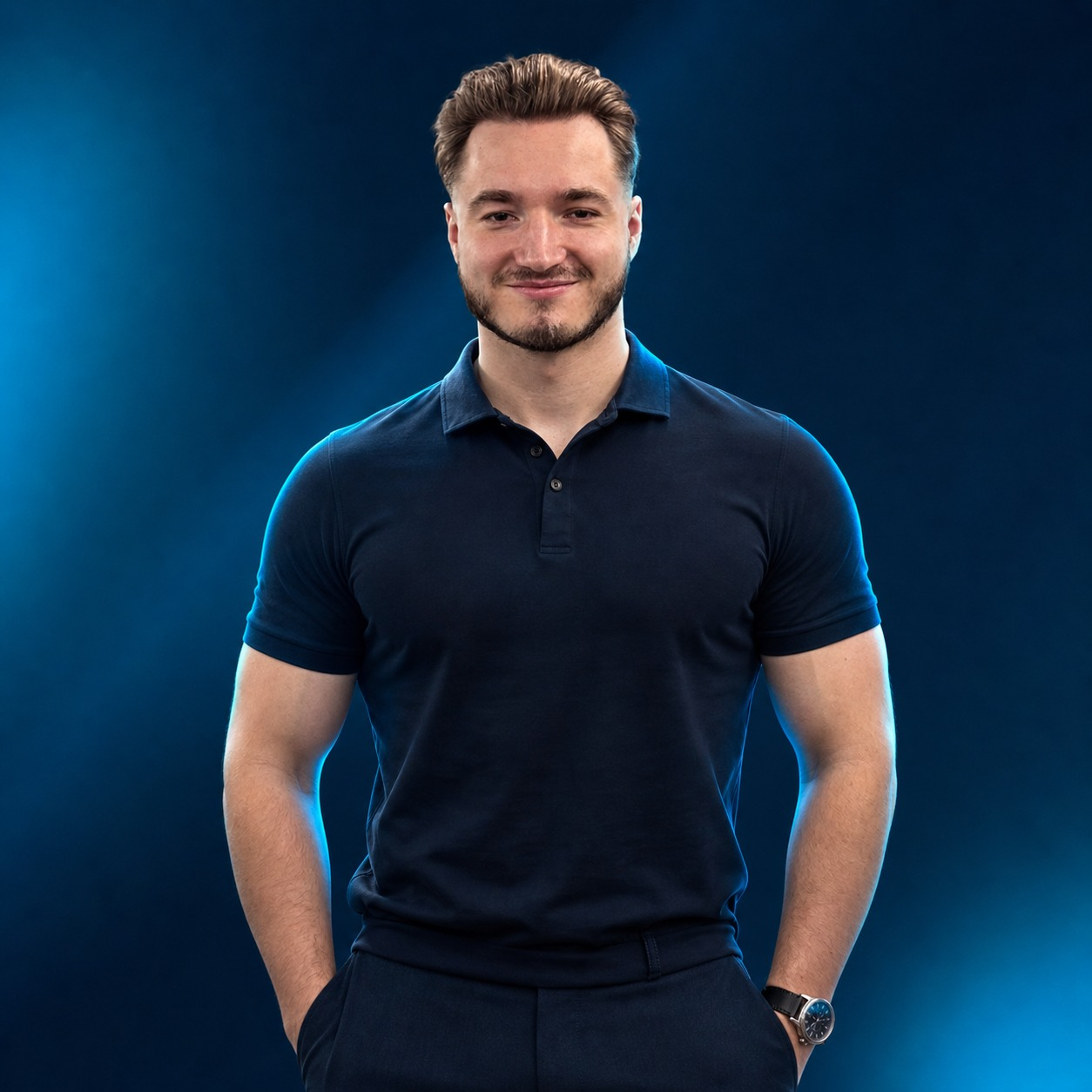
About the Founder
Born in the gym. Not in a boardroom.
Nethletic didn't start as a technology project. It comes from eight years of work by coach František Och, specializing in preparing the body for sports performance, stabilization, correction of the musculoskeletal system, and return to sport after injury.
While working with more than 500 clients, he continuously tested and refined his methods. In 2020, he began combining them into a comprehensive system that connects injury prevention, pain relief, and performance development.
The goal was clear: to transfer the methodology of caring for elite athletes into everyday life. So that everyone could build a more powerful and resilient body without recurring difficulties.
The result is Nethletic. And this is just the beginning.
Why We Exist
Elite Training Protocols Shouldn't Be Locked Behind Professional Sport.
Walk into any gym and you'll see the same thing. People working hard. Getting nowhere. Risking injury. Wasting years. The knowledge that prevents this exists. Top athletes use it every day. It just never reached the people who needed it every day. That's what we're fixing.
What We Stand For
- Real coaching over algorithms. No AI hyper-personalization that gets mislead by self-diagnosis.
- Progressions over templates. Your program leads. Your body follows.
- Long-term results over quick fixes. Built for years, not for an Instagram cycle.
What We Stand Against
- Generic plans rebranded as personalized.
- Random workouts dressed up as training.
- Apps that match your habits instead of developing them.
What Methods We Use
The Same Science. Translated For You.
Nethletic programs are built on three pillars: biomechanics, structured progressions, and long-term periodization. None of this is theory. It is what the largest available datasets in sports science keep proving over and over.
Biomechanics
Every movement is chosen for a reason. The right exercise, in the right order, to develop the right capacity. Joint health, control, and strength built systematically.
Structured Progressions
Every workout is a calculated step up from the last. If a movement is too hard, you swap to a regression. Too easy, you progress up. You're never guessing where you are on the journey.
Long-Term Periodization
Real training isn't a 30-day challenge. It's planned across phases. Build phases. Strength phases. Recovery. We're building toward a system where every season of the year has a purpose.
The Research Behind the Method
Pain Is a Capacity Problem.
"It's your age, your desk job, just live with it." …while nothing truly changes. The real issue isn't a lack of willpower; it's a Capacity Problem.
Most people think back pain or sore tendons come from tight muscles. The instinct kicks in: stretch it out. But the data keeps showing the opposite.
Every tissue in your body — muscle, tendon, ligament — has a load limit. If you don't build that limit up, the tissue stays vulnerable. The stiffness people try to stretch away is usually not the cause. It's the symptom of a tissue compensating for missing capacity and your body trying to prevent injury.
Build the capacity. The symptom disappears.
fewer injuries with strength training.
The largest meta-analysis on injury prevention (Lauersen, Bertelsen and Andersen, 2014) pooled 25 randomized controlled trials covering 26,610 people. Strength training cut overall sports injuries by roughly 66%. Stretching alone showed no convincing preventive effect.
View studyfewer hamstring injuries. Fewer recurrent ones.
Petersen et al. (2011) ran a cluster-randomized trial with 942 footballers. Teams that added a single targeted strengthening exercise (the Nordic Hamstring) cut new hamstring injuries by 60% and recurrent injuries by 85%.
View studylower ACL reinjury risk.
Grindem et al. (2016) followed 106 athletes after ACL reconstruction. Those who met strict strength and symmetry criteria before returning to sport reinjured at 5.6%. Those who didn't reinjured at 38.2%. Targeted strength, control, and symmetry aren't finishing touches. They're the foundation.
View studypain reduction for chronic neck pain.
Andersen et al. (2008) randomized women with chronic neck pain into different training groups. The targeted strength training group saw worst-pain scores drop by 79% over 10 weeks. A larger follow-up (2012) across 447 office workers showed pain reductions in the 47% to 61% range across strength training variations.
View studyfewer injuries with the FIFA 11+.
Soligard et al. (2008), published in the BMJ, randomized 1,892 footballers across a full season. Teams using a structured warm-up built around strength, stability, and movement control saw overall injuries drop 32%. Overuse injuries dropped 53%. Severe injuries dropped 45%.
View studyThe Pattern Is Consistent.
Across hundreds of thousands of training hours and tens of thousands of subjects, the result is the same. Structured strength and progression beat stretching. Every time. By a lot.
The Bridge Analogy
Build the Margin. Life Stops Breaking You Down.
Engineers don't build a bridge to barely hold the cars that drive across it. They build it with several times the needed capacity. That margin is what keeps it safe.
Your body works the same way. The point of training isn't to prepare you for elite sport. It's to build enough reserve that 8 hours at a desk, lifting a heavy box, a weekend hike, or playing with your kids doesn't break you down.
We apply the same prehabilitation and biomechanics principles athletes use. Just scaled for regular life.
Load Limit
Built up
Stiffness
Symptom
Capacity
Progressed
Reserve
Engineered
Why No AI Hyper-Personalization
Real Coaching Beats Algorithmic Guesswork.
Most modern fitness apps lean on AI personalization based on user input. Sounds smart. In practice, it's built on a broken foundation: self-diagnosis. The two are often opposites. An algorithm asking "what are your goals?" and "how do you feel?" just amplifies whatever bad pattern brought the person here in the first place.
Nethletic uses something different. Hand-built progressions tested across 500+ clients. The path isn't generated. It's known. Refined. Proven.
Our History
Day One of Something Much Bigger.
2018
Foundation
8 years ago the work began. Hands-on coaching. Prehabilitation. Performance.
Early 2020
The method takes shape
The first prototype of what would become Nethletic starts being tested.
2020 — 2025
500+ clients
Years of refinement. The formula gets locked in.
2026
Nethletic launches
The Nethletic app launches. Long-term periodization built into the core of the product.
What's Next
A larger ecosystem
Workplace health and networking. The app you see today is the first step.
Train With a Method That Took 8 Years to Build.
Free Quick Workouts, forever — pain relief, correction, and sport warmups. Test the method on the part of your body that needs it most.